Can you tell us a little about yourself?
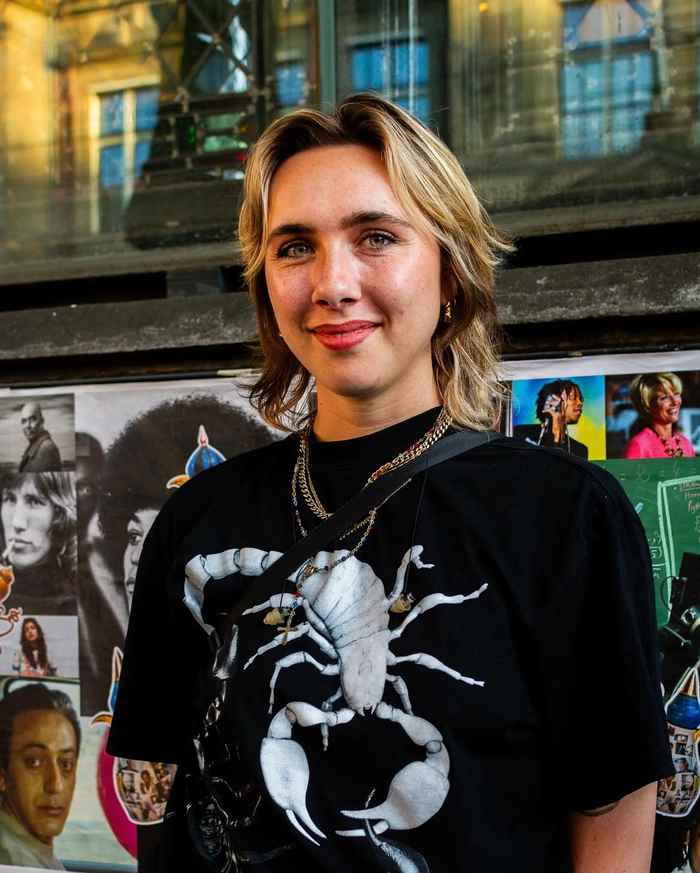
My name is Lola Abbas. I’m 28 years old and have just graduated from the Research Master’s in Literary Studies at the University of Amsterdam. Although I studied literature, I’m particularly interested in ‘reading’ contemporary cultural phenomena: from the use of irony in online memes as a way of dealing with the sometimes harsh realities of life, to political engagement and the paradoxical expressions of nationalism found in song lyrics. Or, on a completely different note, the wooden stool in natural wine bars as a symbol of upward mobility and gentrification.
What connects these topics is my interest in the practices—from consumer behaviour to self-expression and activism—through which we shape and express ourselves, and connect with one another in contemporary society.
What will you be doing at VOX-POP?
I’ll be developing Fragments of Being, a programme consisting of a series of workshops and an exhibition. Throughout the workshop series, participants will be invited to explore their own visual identity and musical sources of inspiration. What role do subcultures play in identity formation today? Which samples have shaped who you are now, and how do you incorporate these elements into the way you present yourself? Has the way we shape and express ourselves changed with the rise of social media platforms such as TikTok?
Indirectly, the programme therefore engages with the larger—and perhaps provocative—question: Is subculture still alive? The outcomes of the workshops will be incorporated into a multimodal exhibition.
What motivates you to create this programme?
I’ve been fascinated by subcultures from a young age. In my case, it started with a hyperfixation on the British Blitz Kids of the 1980s, who gathered at the London club Blitz and were at the forefront of the New Wave movement (look it up). I wanted to be part of the world they had created for themselves: free from restrictions and full of experimentation.
Over time, this fascination developed into an interest in how people ‘absorb’ fragments of what they see around them, make them their own and incorporate them into their self-expression. In a world where self-expression increasingly seems to be linked to hyper-consumption and fast fashion, and where young people are often said to spend more time on their phones than with one another, I’m curious about how true this really is—and how much it influences young people’s sense of identity and connection.
Who is this programme for? Why should people attend, and what might they take away from it?
This programme is for anyone interested in music, fashion and self-expression in any form. Whether you’ve spent your whole life refusing to mix Nike with Adidas, or you go full cottagecore one day and dedicate yourself to a dark academia aesthetic the next—everyone is welcome.
The only thing that matters is a willingness to question yourself and perhaps surprise yourself in the process. That is also what I hope the programme will offer: an open exploration of the role of subcultures in an increasingly digital world, hopefully leading to new and unexpected insights.
What do you hope to gain from your time as a student resident?
I hope to learn how to translate my sometimes niche interests into a concrete question or theme that can engage a wider audience. I also hope—and expect—to be confronted with the limits of my own perspective, as that is something I’m eager to learn from.
Above all, I’m looking forward to being surprised by the fragments of themselves that everyone brings to this programme—and by the ways in which those fragments might, in turn, leave their mark on me.