Can you tell us a little about yourself?
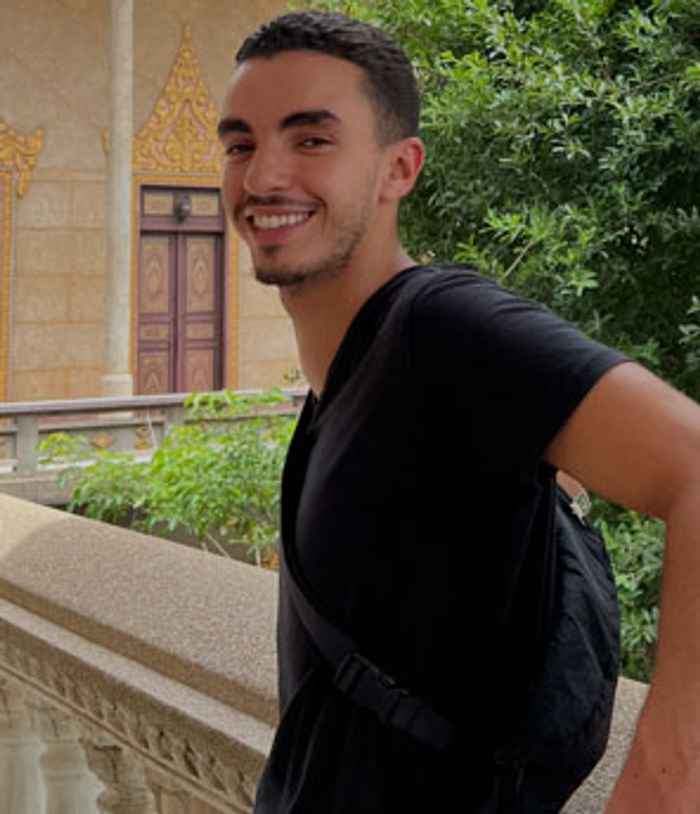
My name is Mohamed El-Hirech, and I’m from Amsterdam. I studied Sociology and Middle Eastern Studies at the University of Amsterdam, and in September 2026, I will begin a Master’s programme in Conflict Resolution and Governance. As a first-generation student, I quickly learned that you have to seize opportunities for yourself whenever you can. Connection, curiosity and social engagement are central to who I am. These values form the common thread running through my interests and the projects I take on.
What will you be doing at VOX-POP?
VOX-POP is the creative hub of the Faculty of Humanities, where exciting events and projects are organised by and for students. VOX-POP also offers talent development programmes, including residencies that give students the opportunity to independently develop and organise their own projects.
I am currently taking part in one of these residencies and am organising Herkomst en Horizon, a project consisting of an exhibition and a series of events. Herkomst en Horizon explores the diversity of the Moroccan community in the Netherlands through an interdisciplinary lens. The exhibition features works by various artists and makers from across the Netherlands, exploring themes such as migration, cultural heritage and the connections between the Netherlands and Morocco. The accompanying programme includes, among other things, a film screening and a henna workshop.
What motivates you to create this programme?
On the one hand, my own background and cultural identity as a Moroccan-Dutch person naturally play a central role in my motivation for organising this programme. As a Dutch person with a migration background, you are often reminded of your bicultural identity. Sometimes, you may even feel that you have to choose between your different identities, that you are not allowed to take pride in them both, or that you have to justify certain aspects of who you are.
With this programme, I want to show that being Dutch while having roots elsewhere is not always easy, but that this bicultural identity can also be a real source of enrichment. I hope to contribute to a more nuanced understanding of identity and show that it is layered and complex. It is not as black and white as people often assume.
I also see this as a valuable opportunity to learn more about myself and my own cultural identity, while helping others learn more about it too. And, of course, having the opportunity to organise your own project is something quite special!
Who is this programme for? Why should people attend, and what might they take away from it?
This programme is for anyone interested in stories about migration, cultural heritage, diaspora and what it means to feel at home somewhere. Naturally, it may be particularly relevant to Dutch people with Moroccan roots, but I believe many people will be able to relate to the project, whether or not they have a migration background.
The programme is open to anyone who feels connected to the themes and wants to explore them further. More broadly, it will also appeal to art and culture lovers, as well as open-minded people who are curious to learn something new and broaden their perspectives. In short: everyone is welcome, as long as they come with an open mind. Above all, I hope this project sparks meaningful conversations and brings people together.
What do you hope to gain from your time as a student resident?
Above all, I hope to learn much more about cultural identity in general and the Moroccan community in the Netherlands in particular. I also hope to inspire other students—especially those with a migration background or those who are the first in their family to attend university—to be proactive and carve out a space for themselves. Often, there is more possible than you might think.
I hope this period will bring me new insights and connections, both personally and professionally. I would love to continue working as a programme maker within the arts and culture sector, although I have already learned that organising a programme demands a great deal from you: patience, adaptability and creativity, among other things. So it has certainly been a learning and development journey.