Close Up 9.3 Sounds of Solidarity
Joy of Resistance
- Date
- 23 April 2026
- Time
- 19:00 -22:00
- Location
- BG 3
- Room
- VOX-POP (binnengasthuisstraat 9)
Join us for an inspiring afternoon that bridges academic theory and rhythmic practice.
We begin with an open conversation on decolonialism, solidarity, and community with philosopher Monique Roelofs - researcher on decolonial, Black, and feminist aesthetics - and the Baque Flamingo collective, a collective fighting for queer liberation and anti-racism. Together, we’ll explore what defines resistance today, the power of non-dominant voices, and the complex links between Dutch colonial history and Brazilian culture.
Shift from theory to embodiment with a Maracatu workshop led by Baque Flamingo. Originating as an Afro-Brazilian anti-colonial resistance, Maracatu is a decolonial practice in itself. By drumming together, we physically take up space and demonstrate how cultural expression serves as both a shield and a weapon.
Practical information
This event takes place at VOX-POP (Binnengasthuisstraat 9), ground floor. Entry is free, however, we do kindly ask you to registrate.
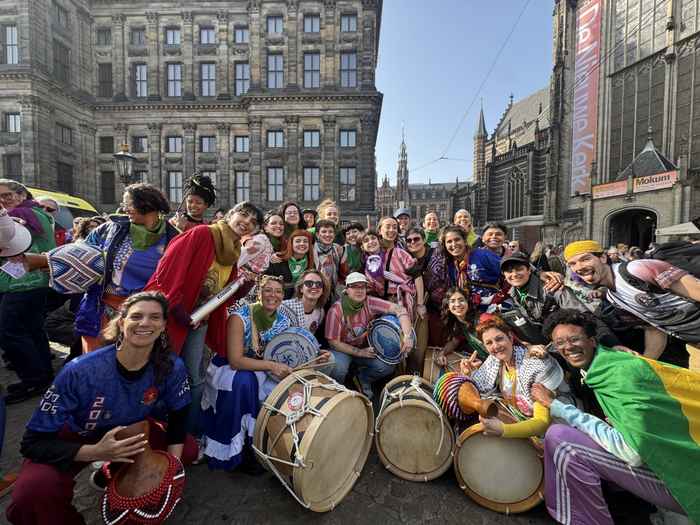
Baque Flamingo is a collective founded in 2019, in which we play Maracatu de Baque Virado, from the Northeast of Brazil. We play and sing to bring about change, connection, and empowerment in ourselves and around us. We fight for queer liberation, anti-racism, economic equality, feminism, environmentalism, and religious freedom. Most importantly, we act in solidarity with communities that actively resist against structures of oppression. That is why it is so important to us to learn from Maracatu Nations and support their continued manifestation and resistance.